
This article was originally posted in Portuguese on Medium in February 2017.
Check it out here.
At some point over the past few years, you’ve almost certainly run into the phrase “user experience.” It isn’t a hard idea to grasp: it refers, quite literally, to how users interact with products, systems, and processes. And this concept that keeps drawing attention is a decisive factor in whether a product succeeds.
In an online world where everything has become faster and more immediate, we’re one click away from countless alternatives, which is exactly why every detail matters.
What sets apart two products that solve the same problem is the value users see in one of them. That’s why the experience of using it has to be thought through down to the smallest detail.
So while the concept of user experience may seem obvious, it’s also broad, touching on many aspects of how human beings position themselves in the world.
<iframe width="560" height="315" src="User experience encompasses all aspects of the end-user’s interaction with the company, its services, and its products.The first requirement for an exemplary user experience is to meet the exact needs of the customer, without fuss or bother. Next comes simplicity and elegance that produce products that are a joy to own, a joy to use. True user experience goes far beyond giving customers what they say they want, or providing checklist features. In order to achieve high-quality user experience in a company’s offerings there must be a seamless merging of the services of multiple disciplines, including engineering, marketing, graphical and industrial design, and interface design. - Don Norman
"...to meet the exact needs of the customer, without fuss or bother"
— Don Norman and Jakob Nielsen, 1998
For an experience to unfold the way Norman describes, several factors have to come together. Some of them come entirely from the person living it, such as their mood in the moment. Others, though, fall to the people building the product.
That means you need to know and understand the environment your product lives in: who the user actually is, what context they’re in, how they use it. Keep in mind that users don’t experience your product only while they’re using it. There’s an entire journey that begins before they even get their hands on it, and that’s why information will be your greatest ally here. You’ll need it to map each of these pieces and build a solid foundation for shaping the experience at every point of contact between user and product.
Only once you’ve done the research and gathered what you need do you have the grounding to make real choices in pursuit of a better experience.
Your own knowledge of the product is valuable for some of those decisions, but never forget that you are not your user. [Worth noting that research doesn’t have to run in a waterfall sequence. It can happen at different moments, depending on what the project needs. We’ll dig into this in a future post.]
Experiences are happening constantly, and most of the time we aren’t reflecting on them. A good experience is invisible. It flows, allowing the user to become fully immersed in the product. You don’t have to think about what you’re doing or how it should be done; the interaction is entirely intuitive.
A break in that immersion signals a bad experience, because the user now has to stop and reconsider what’s actually going on before deciding what comes next. That introduces complexity and ruptures the expectations they had around using it.
The Uber phenomenon
Uber is one example of how you can build a product that delivers a good experience across the entire user journey. The company created a mobile app designed to offer an alternative for getting around a city, or even between cities.
The user experience here isn’t limited to its remarkable interface, which makes requesting a ride feel completely trivial despite all the complexity involved: payment processing, geolocation, price estimates, and the app’s other features. It extends across the whole process, where the person who requested the ride is served to a consistently high standard, at genuinely accessible prices (which is part of the experience too, since price directly shapes the expectations of the people using it, as mentioned above).
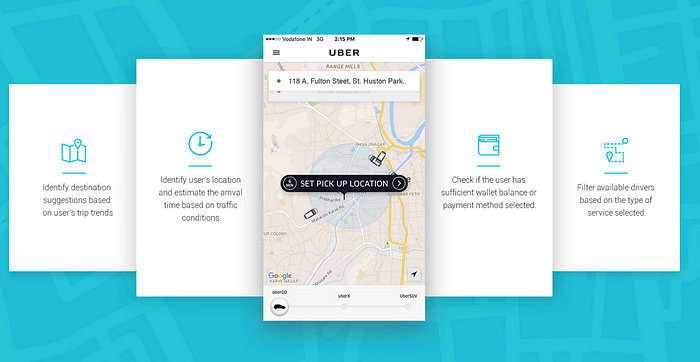
All of this is why Uber is considered a disruptive company: it was able to change an established market by (re)thinking the entire environment surrounding the use of its product.
Invisible as they are, good experiences leave a mark on the people who live them. If your product can deliver that kind of experience, you can be confident it’s on the right track, because it has met three basic requirements: usefulness (I need to use it), usability (I can use it), and desirability (I want to use it).
Let’s get to work
So go find the information you need, create personas, map the points of contact, brainstorm, lean hard on design thinking techniques, use every tool within your reach, and make sure you’re doing your best to deliver a product capable of giving users a great experience.
Don’t assume there’s one person responsible for creating experiences. Experiences happen regardless. What you can do is involve everyone in a process that makes a good one possible.
Reference: https://www.nngroup.com/articles/definition-user-experience